



In this Blog:
- Why driver readiness and why now?
- What are fleets missing today?
- Why four phases instead of one readiness check?
- Fit to Drive: start with the driver, not just the assignment
- Compliant at Dispatch: do not release what is not in standard
- Stay in Standard: readiness must hold after the vehicle leaves
- Return to Ready: end the day with closure, not carryover risk
- What fleets gain when driver readiness is governed
- Where this goes next
Executive brief
Driver readiness is not one check at the start of the day. It is the full operating condition of the driver across the workday. Rhythm Innovations helps fleets govern the four moments that matter most: fit to drive, compliant at dispatch, stay in standard, and return to ready. Instead of leaving readiness spread across files, handoffs, and memory, Rhythm brings it into one command-center process where issues become decisions, decisions get owners, and closure is proven.
That approach lines up with the real world. Federal Motor Carrier Safety Administration (FMCSA) requires carriers to maintain driver qualification files, verify medical qualification, run required Drug and Alcohol Clearinghouse queries for covered Commercial Driver’s License (CDL) drivers, manage hours-of-service limits, and handle vehicle inspection and defect closeout duties. Public safety agencies also continue to warn that fatigue and drowsy driving raise crash risk. In other words, driver readiness is already a multi-condition problem. The failure point is often not whether the fleet had incoming data. The failure point is whether the fleet governed that incoming data in time.
Why driver readiness and why now?
For many fleets, driver readiness is still treated like a narrow pre-trip or dispatch question. Is the driver here? Is the truck available? Are we good enough to move? But the workday is more demanding than that. A driver can look fine at the start of the shift and still drift out of standard during the day. A vehicle can leave the yard and still come back with unresolved defects that quietly become tomorrow morning’s problem. A qualification issue can sit in a file until the wrong event makes it impossible to ignore.
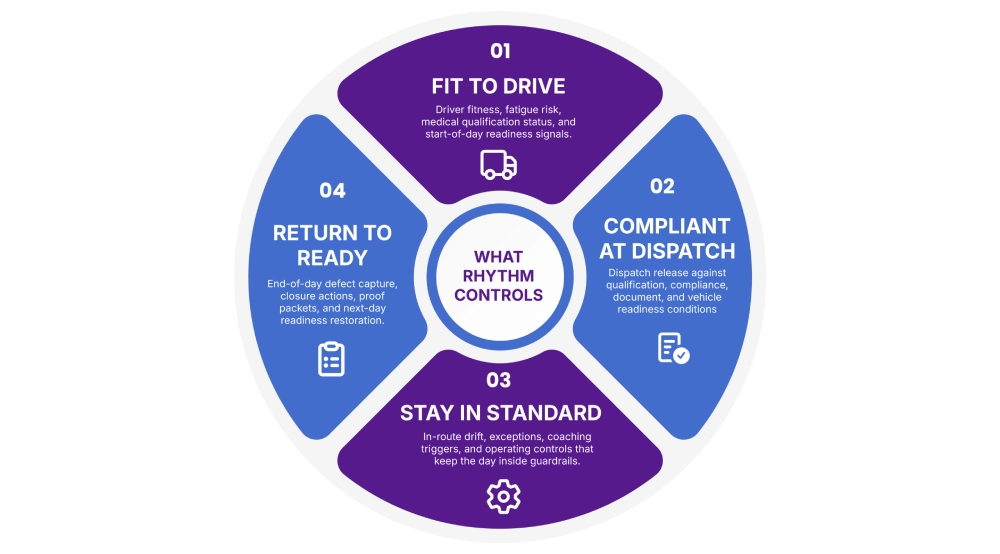
That is why Rhythm treats driver readiness as a workday discipline, not a one-time task. The model runs through four phases: Fit to Drive, Compliant at Dispatch, Stay in Standard, and Return to Ready. Each phase answers a different question. Together, they create control across the full driver day.
What are Fleets missing today?
In most operations, the problem is not that there is no incoming data. The problem is that the incoming data is scattered. Some of it sits in qualification files. Some of it lives in telematics. Some of it is known by dispatch. Some of it is buried in vehicle inspection records. Some of it only becomes visible after something already went wrong.
That fragmentation creates three common failure points. The first is missed readiness at the start of the day. The driver is scheduled and the unit is available, so the operation moves even though something important is unresolved. The second is drift during the day. Standards erode after dispatch. Hours stretch. Behaviors repeat. Supervisors get noise instead of clarity. The third is carryover risk at the end of the day. Defects are noted, but ownership is weak. Actions are unclear. Closure is assumed instead of proven. Rhythm is designed to solve those three failures by putting fleet risk, compliance risk, and claims into one operating view. That changes readiness from a paperwork exercise into a managed process.
Why four phases instead of one readiness check?
Because fleets do not fail in one moment. They fail across a chain.
A pre-trip check matters, but it does not answer every question that matters. It does not fully answer whether the driver is truly fit to drive. It does not fully answer whether the dispatch release should proceed. It does not protect against in-day drift. And it does not ensure the next shift starts clean.
The four-phase model matters because each phase controls a different exposure:
- Fit to Drive asks whether this person should operate right now.
- Compliant at Dispatch asks whether the driver, vehicle, and records are in condition to be released.
- Stay in Standard asks whether the operation remains inside guardrails as the day unfolds.
- Return to Ready asks whether the day ended with true closure or whether hidden risk is being pushed into tomorrow.
1. Fit to Drive: Start with the driver, not just the assignment
The first question in driver readiness should be simple: should this person drive right now?
That sounds obvious, but it breaks down more often than companies think. A driver may be licensed, employed, and already on the board, yet still be outside safe operating condition because of fatigue, medical status, impairment risk, or another unresolved readiness issue. Rhythm’s Fit to Drive phase is built to catch that before movement begins.
This matters because readiness is not theoretical. FMCSA requires carriers to ensure interstate Commercial Motor Vehicle (CMV) drivers meet general qualification standards and maintain a qualification file for each employed driver. FMCSA also says interstate commercial drivers must maintain a current Medical Examiner’s Certificate, and the physical qualification exam confirms the driver is healthy enough to safely perform the job. Employers of CDL drivers must also conduct a Clearinghouse query at least once per year for each CDL driver they employ, and pre-employment query rules apply before safety-sensitive work begins. [1] [2] [3] [4]
Fatigue belongs in the same conversation. FMCSA says hours-of-service rules help ensure drivers stay awake and alert. The National Highway Traffic Safety Administration (NHTSA) estimates that 91,000 police-reported crashes in 2017 involved drowsy drivers and notes that the true impact is likely underestimated. The Commercial Device Class/National Institute for Occupational Safety and Health (CDC/NIOSH) says driver fatigue is a major workplace safety risk and warns that after 17 consecutive hours awake, impairment is equivalent to a blood alcohol content of .05; after 24 hours awake, it is equivalent to .10. [5] [6] [7]
Rhythm helps by moving those conditions into one operating view and one release logic. Managers should not have to hunt through files, emails, and separate systems just to answer a yes-or-no readiness question. A missing medical status, unresolved Clearinghouse obligation, fatigue trigger, or supervisor concern should become an exception that requires a decision before the day starts.
2. Compliant at Dispatch: Do not release what is not in standard
A driver can be fit enough to work and still not be compliant for dispatch.
That distinction matters. Dispatch is not just the moment when work begins. It is the release point. It is where the company decides whether the driver, assignment, and vehicle are all in acceptable condition to move.
Too often, that decision is made with partial information. A document is assumed current. A qualification item is assumed complete. A prior defect is assumed closed. But dispatch should not run on assumptions. It should run on current condition.
FMCSA’s driver qualification file guidance makes clear that carriers must maintain a qualification file for each employed driver. FMCSA’s vehicle inspection guidance also states that before operating the vehicle, the driver must inspect the vehicle and be satisfied that it is in safe operating condition. If the last vehicle inspection report notes deficiencies, the driver must review and sign to acknowledge and certify that required repairs were made. [2] [8]
Rhythm’s dispatch model turns readiness into a governed go or no-go decision. If qualification evidence is incomplete, if a required review is unresolved, if a vehicle issue remains open, or if a compliance condition has not been met, the system surfaces that exception before the release happens. The point is not to slow the business down. The point is to stop preventable exposure from being released into the day.
3. Stay in Standard: Readiness must hold after the vehicle leaves
This is the phase many fleets miss.
A lot of operations put real effort into pre-trip and dispatch, then lose control once the day is underway. But driver readiness does not end when the unit leaves the yard. In some ways, that is where the harder work starts. Hours extend. Fatigue builds. Unsafe behaviors repeat. Coaching triggers pile up. Supervisors hear about problems late, and by the time someone reacts, the operation has already drifted.
FMCSA says hours-of-service regulations exist to help ensure drivers stay awake and alert. The CSA’s (Compliance, Safety, Accountability) Safety Measurement System further organizes carrier performance around categories such as Unsafe Driving, Hours-of-Service Compliance, Driver Fitness, Controlled Substances/Alcohol, Vehicle Maintenance, and Crash Indicator. Those categories show why driver readiness cannot stop at the gate. A fleet may begin the day in standard and still move out of standard through speeding, fatigue, late-day overextension, unaddressed vehicle issues, or repeated behavior patterns. [5] [11]
Rhythm treats the middle of the workday as its own governed phase for that reason. Stay in Standard is about keeping the day inside required guardrails, not just documenting what happened after the fact. Supervisors need more than alerts. They need line of sight into what is outside standard, who owns it, what must happen next, and whether the issue was actually closed. Instead of flooding the operation with disconnected notices, Rhythm organizes in-day exceptions into something leaders can act on.
4. Return to Ready: End the day with closure, not carryover risk
The last phase is often the most overlooked, and it may be the most important.
A fleet can manage the first part of the day well and still lose ground if the day ends badly. A defect is noted but not owned. A corrective action is implied but not assigned. A repair is assumed complete but not proven. That is how tomorrow’s problem is created the night before.
FMCSA’s Driver Vehicle Inspection Report (DVIR) guidance says a motor carrier or its agent must state in writing that reported defects or deficiencies were corrected or that correction was unnecessary, and that declaration must be followed by the signature of the person making it. FMCSA also says certification must be made that all reported defects or deficiencies have been corrected or that correction was unnecessary. [9] [10]
Return to Ready is Rhythm’s answer to that gap. It treats the end of the workday as a restoration point. The goal is not just to record that something happened. The goal is to show what happened, who owns the next action, what the due time is, and what evidence confirms closure. That is where the proof packet matters: the issue, the decision, the owner, the action taken, and the confirmation that the unit or driver is back in standard.
What fleets gain when driver readiness is governed
When fleets govern readiness across all four phases, they gain more than compliance coverage. They gain control over the workday.
They reduce preventable exposure because issues are caught earlier. A driver who is not fit to drive can be stopped before dispatch. A vehicle defect can be handled before it becomes a roadside problem. An in-day exception can be acted on before it becomes repeat behavior.
They improve supervisor clarity because exceptions are visible, owned, and timed. Instead of chasing emails, files, phone calls, and disconnected updates, leaders get one operating view of what is outside standard, what decision is required, who owns it, and whether it was closed.
They strengthen trust with insurers, brokers, auditors, and customers because the company can show what happened and what was done. And they become more dependable because dispatch improves, in-day drift is reduced, and end-of-day defects are less likely to roll into tomorrow.
This is the shift from reactive fleet management to governed operations. Driver readiness stops being treated like a file problem and starts being managed as a daily discipline.
Where this goes next
The bigger opportunity is not just cleaner compliance. It is a better operating model for fleets.
When readiness is governed correctly, the fleet begins to connect moments that were previously treated as separate: qualification, dispatch, supervision, defect closure, claims posture, and insurer confidence. The workday is no longer managed through scattered handoffs. It is managed through one controlled flow.
That is why Rhythm’s Command Center matters. It gives the business one place to understand what is out of standard, what decision is required, who owns it, and whether the issue is actually closed. In other words, it gives fleets a practical way to run readiness as a command-center discipline rather than a disconnected set of checks.
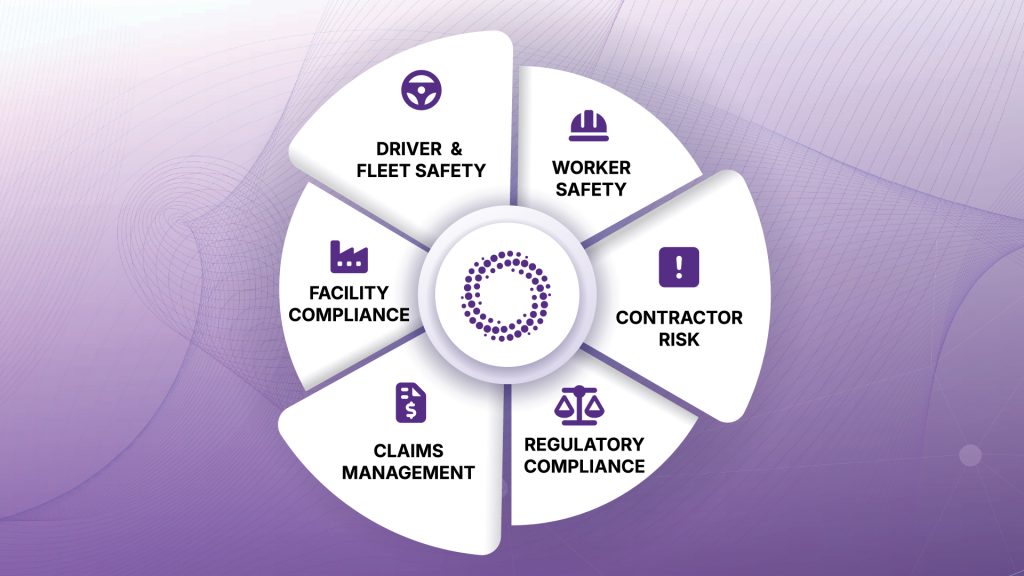
Rhythm Value Proposition! How does Rhythm Innovations help you with driver readiness? It helps by governing the four moments that determine whether the driver is truly ready, whether the dispatch should proceed, whether the day is still in standard, and whether tomorrow starts clean.
If a fleet is still managing driver readiness through files, memory, and disconnected systems, there is a better way.
Glossary of Key Terms
The terms below give plain-language definitions for the key concepts used throughout this paper.
- Driver Readiness: The full operating condition of the driver across the entire workday, not just a single pre-trip check.
- Fit to Drive: The first phase of the day. It answers whether the driver should operate right now based on readiness signals such as fatigue, medical status, and impairment risk.
- Compliant at Dispatch: The release point before work begins. It confirms the driver, vehicle, and required records are in acceptable condition for dispatch.
- Stay in Standard: The in-day control phase. The driver and operation remain inside the required safety and compliance guardrails during the workday.
- Return to Ready: The closeout phase of the workday. Defects, issues, and exceptions are captured, assigned, resolved, and documented so the next day starts clean.
- Command Center: Rhythm’s operating view that brings signals, exceptions, owners, due times, and closure evidence into one place.
- Exception: Anything outside the required standard that needs action, such as an expired medical card, unresolved defect, late compliance item, or open readiness issue.
- One Decision, One Owner, One Due Time: Rhythm’s accountability rule for exceptions. Each issue should end in one clear action, one named owner, and one required completion time.
- Proof Packet: The documented record of the signal, the exception, the decision made, the owner, the due time, and the evidence that confirms closure.
- Driver Qualification File (DQ File): The required driver record set maintained by the carrier to show the driver meets qualification standards.
- Clearinghouse: The FMCSA Drug and Alcohol Clearinghouse used to verify whether CDL drivers have unresolved violations that affect eligibility for safety-sensitive work.
- Hours of Service (HOS): The federal rules that limit driving and work time to reduce fatigue risk and help keep drivers awake and alert.
- CSA and BASICs: FMCSA’s Compliance, Safety, Accountability program and its behavior categories, which show where a carrier is drifting into risk.
- DVIR (Driver Vehicle Inspection Report): The end-of-day inspection record used to capture defects and confirm whether repairs were completed or not needed before the vehicle returns to service.
- Claims Defensibility: The ability to show, with evidence, what the company knew, what it did, who acted, and whether the issue was properly controlled.
Reference
- FMCSA – Hiring Qualified Drivers (Part 391) – https://csa.fmcsa.dot.gov/safetyplanner/MyFiles/Sections.aspx?ch=23&sec=66
- CSA Safety Planner – Driver Qualification File – https://csa.fmcsa.dot.gov/safetyplanner/MyFiles/SubSections.aspx?ch=23&sec=66&sub=152
- FMCSA – Driver Physical Qualification – https://www.fmcsa.dot.gov/medical/driver-medical-requirements/driver-medical-fitness-duty
- FMCSA Drug & Alcohol Clearinghouse – Annual Query Requirement – https://www.fmcsa.dot.gov/regulations/drug-alcohol-testing/what-annual-requirement-employee-queries-and-how-it-tracked
- FMCSA – Hours of Service – https://www.fmcsa.dot.gov/regulations/hours-of-service
- NHTSA – Drowsy Driving – https://www.nhtsa.gov/risky-driving/drowsy-driving
- CDC/NIOSH – Driver Fatigue on the Job – https://www.cdc.gov/niosh/motor-vehicle/driver-fatigue/index.html
- CSA Safety Planner – Vehicle Inspections – https://csa.fmcsa.dot.gov/safetyplanner/MyFiles/SubSections.aspx?ch=22&sec=65&sub=148
- FMCSA – Driver Vehicle Inspection Reports – https://www.fmcsa.dot.gov/safety/driver-vehicle-inspection-reports-4
- FMCSA – Driver Vehicle Inspection Report Certification – https://www.fmcsa.dot.gov/safety/driver-vehicle-inspection-report
- CSA – Safety Measurement System (SMS) / BASICs – https://csa.fmcsa.dot.gov/about/Measure